Identification
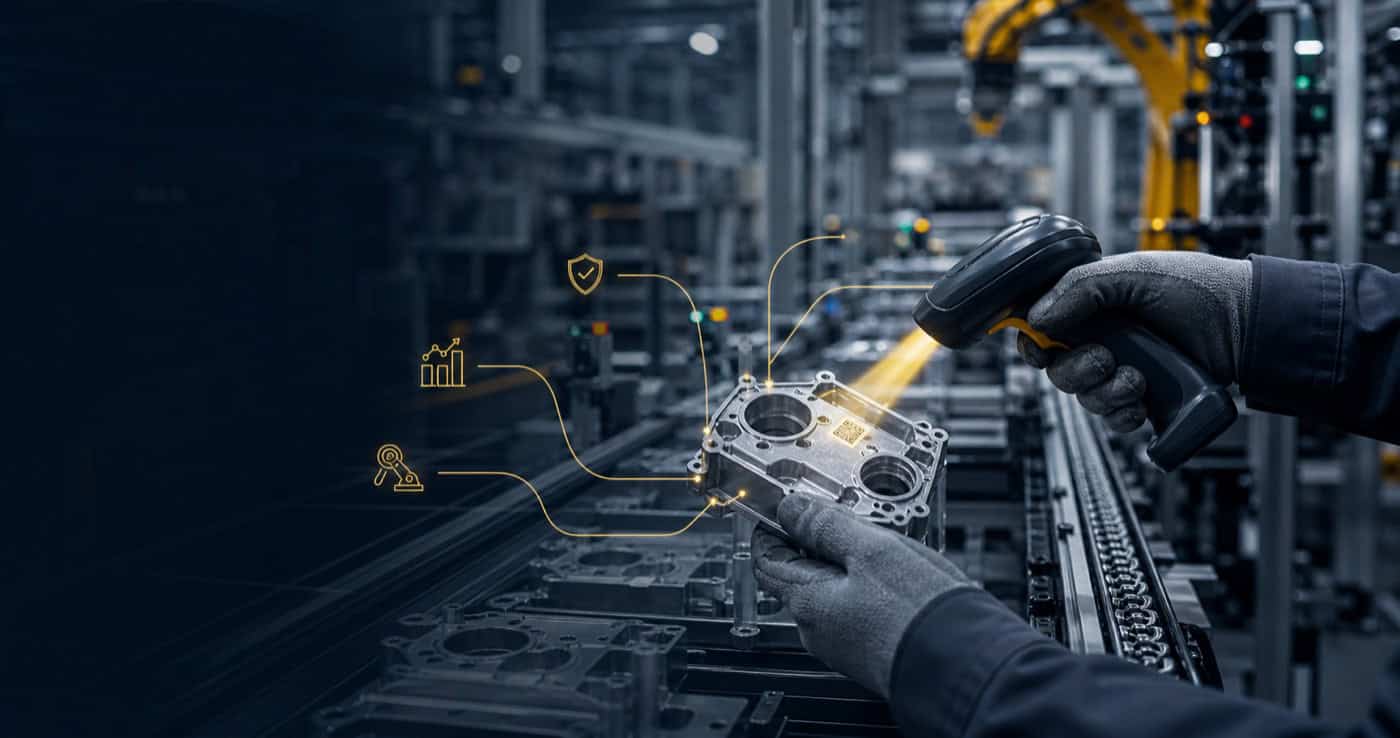
A barcode, QR code, RFID tag, OCR, serial number or batch number identifies the product or component.

A practical guide to product traceability
Traceability connects a product with its raw materials, components, workstations, measurements and operators. It enables a manufacturer to reconstruct the production history of a specific item or batch — from material receipt to the finished product.
Project experience for manufacturing plants and industrial brands


The ability to uniquely identify a product, batch or component and reconstruct its origin, process history and subsequent journey from recorded data.
In manufacturing, traceability creates a digital record of what actually happened on the production line. A system can record the components used, consecutive operations, test results, process parameters, time, workstation and the person who performed an activity.
It is not limited to locating a product. Full traceability also answers: what the product was made from, which operations it passed through, what the outcome was and which process configuration was active.
From a signal to product history
The system links a product identifier with data collected at successive process stages. A shared database then makes it possible to reconstruct the complete product journey.
A barcode, QR code, RFID tag, OCR, serial number or batch number identifies the product or component.
Data comes from PLCs, I/O, scanners, cameras, scales, testers and higher-level systems.
Measurements and events are assigned to the PartId, operation, workstation and timestamp.
Process rules determine OK, NOK or BLOCKED status and whether rework is required.
Data is stored in the database and reports and can be shared with MES, ERP or SCADA.
A digital process record
The scope depends on the industry, product and implementation goal. The following information groups are recorded most often.
PartId, serial number, production order, batch, product variant and status.
Parent–child relationships, materials, components and input batches used.
Process sequence, workstation, machine, line, date and exact operation time.
OK/NOK status, torque, pressure, temperature, weight and other quality parameters.
User, role and active recipe, program, rule or process configuration version.
Alarms, blocks, repeated operations, rejection reasons and the audit trail.

Identification and integration
No single method suits every process. Codes are economical and straightforward to deploy, RFID enables reading without direct line of sight, while OCR uses markings already printed on the product. Process data can also be collected directly from devices and control systems.
Quality, safety and efficiency
The greatest value is the ability to move quickly from a general problem to a specific product, batch, workstation and event.
Product history helps identify the source of a problem without manually combining multiple files.
Identify the affected batch, products or components rather than recalling all production.
Results and parameters are available in the context of the product, station and process version.
Automatic data capture reduces result transcription and the risk of human error.
Data, configuration versions and user activity create a clear audit trail.
Comparing results across shifts and workstations helps detect recurring causes of loss.
Two complementary systems
The systems can work together, but they are not the same. Traceability focuses on product history and identification, whereas MES covers the broader execution and management of manufacturing.
| Area | Traceability system | MES |
|---|---|---|
| Primary objective | History of products, batches and components | Management and supervision of manufacturing execution |
| Typical data | PartId, genealogy, measurements, statuses and rework | Orders, schedules, resources, performance and OEE |
| Implementation scope | Can start with one workstation or line | Usually covers a broader organisational scope |
| Cooperation | Can supply structured production data to MES | Can issue operations and receive their results |
From knowledge to a working solution
When you are ready to move from the concept of traceability to a specific implementation, discover TraceSmart. It is a modular hardware and software solution with its own database, operator interface, reporting and integration with MES, ERP and SCADA.
Systems working in production
We combine traceability expertise with practical integration experience on manufacturing lines.

Component identification and production-process data integration.
View realisations →
Production control and product-history recording for the automotive industry.
View realisations →
Automatic marking recognition, serial-number assignment and integration with production control.
View realisations →Frequently asked questions
Let us discuss your production process
We will review your data sources, identification method and integration requirements, then propose a traceability architecture tailored to your production line.